
The Project
Project Spark is a Meta initiative designed to empower low-income high school students with critical computer science skills. This 5-day, project-based curriculum seamlessly blends core academic subjects with computer science concepts and real-world applications.
Students create comprehensive projects—like games and predictive models—using their knowledge of core subjects and professional contexts, preparing them for future opportunities.
To create a seamless learning experience, we structured Project Spark into three key components: the design system, the dashboard, and the classes—each playing a crucial role in empowering both teachers and students.
My Role
As Design Lead for Project Spark, I oversaw a talented team of 2 art directors and 3-4 graphic designers and illustrators. Beyond leading the team, I personally designed the design system, teacher and student dashboards, as well as the Physics class experience.
Collaboration was at the heart of my role. I worked closely with stakeholders, the leadership team, project managers, engineers, illustrators and copywriters to ensure alignment and success.
Operating in an agile environment, I facilitated regular standup meetings with stakeholders and our team, ensuring the timely delivery of a high-quality product. I also managed design team estimates, balancing creativity with efficient project execution.

Teacher and Student Platform
We designed two platforms—one for teachers and one for students—each tailored to their unique needs:
Teacher Dashboard: A centralized hub that gave teachers control over asynchronous and live classes, student rosters, and grading. It streamlined lesson facilitation, making it easy to track student progress and manage coursework.
Student Platform: A dedicated space where students could log in, access classes, submit their final projects, and view their grades. The goal was to create an engaging, distraction-free interface that made learning feel intuitive and rewarding.


Physics
Physics
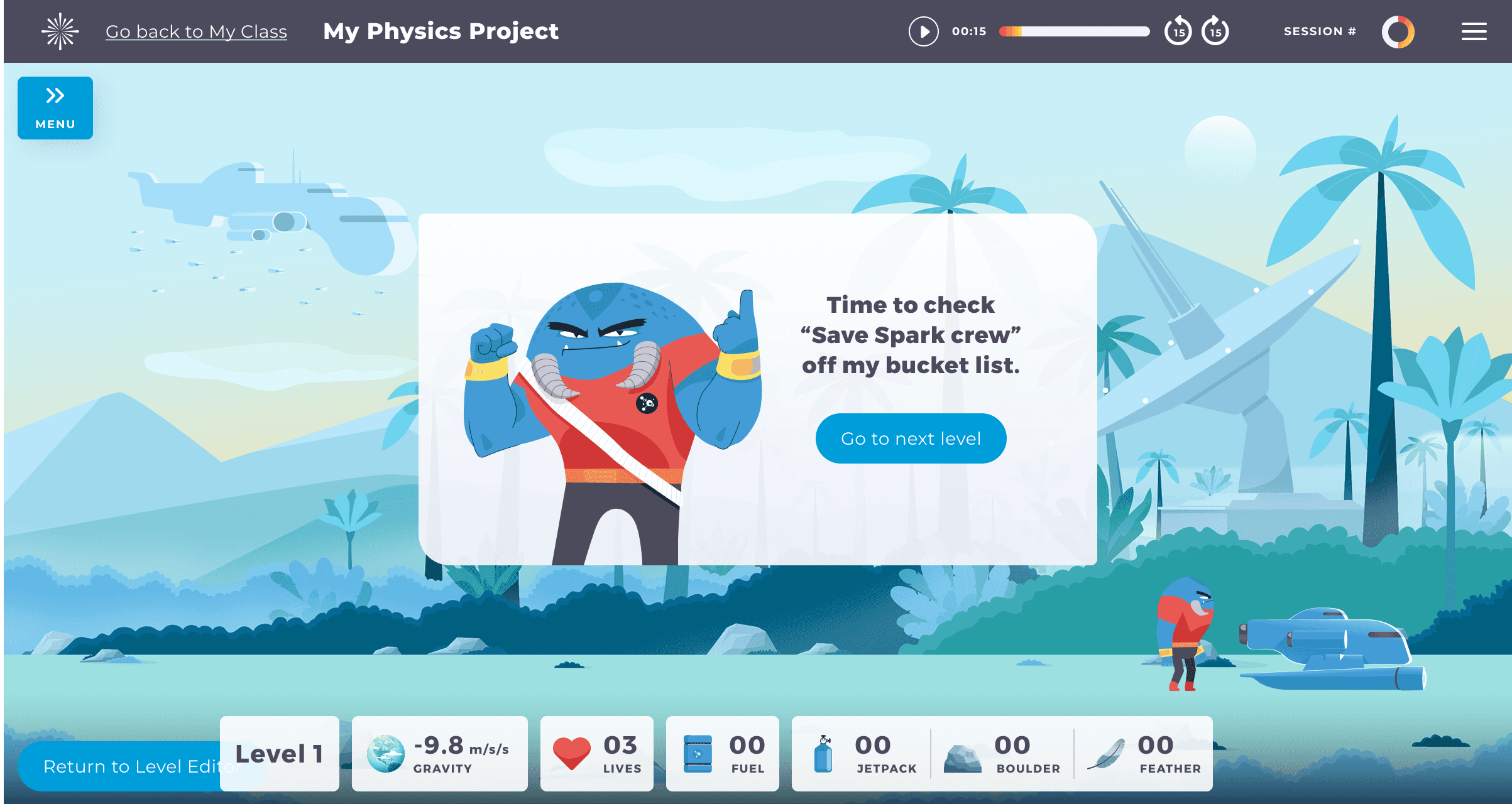
Students take on the role of game designer to build a multi-level, two-dimensional platformer. Their project goal is to create a game that is challenging and exciting for the player. Students learn about both game design and game physics, using Physics laws of motion to make their game objects move on screen.
Key features:
Game editor
Inquiry-based digital experiments
Instant game simulation feedback



Algebra & US History
Algebra
Students take on the role of urban planners, making decisions about land use in their cities. They use the Algebra I concepts of systems of linear equations to place their chosen objects in a city grid. Then they use a computer simulation to measure the happiness of different resident populations. They use the simulation data to inform their next building decision.
Key features:
Problem-based scenarios
Algebra graphing tool
Simulation tool
US History
Students take on the role of historical data scientists to conduct an investigation into the Immigration Act of 1924. Students create data visualizations from historical census and immigration data and use predictive modeling that tell their immigration story.
Key features:
Interactive timeline of historical events
Deep predictive modeling tool
Customizable visualizations tool


